Target Is Reinventing Its Beauty Department. Here’s What Independent Beauty Retailers Need to Know.
Target Beauty Studio is bringing 90 beauty brands, dedicated advisors and specialty-store-style curation to more than 600 locations. For independent beauty retailers, competing with it means doing what small stores already do best.
I love Target, and I want to establish that from the start.
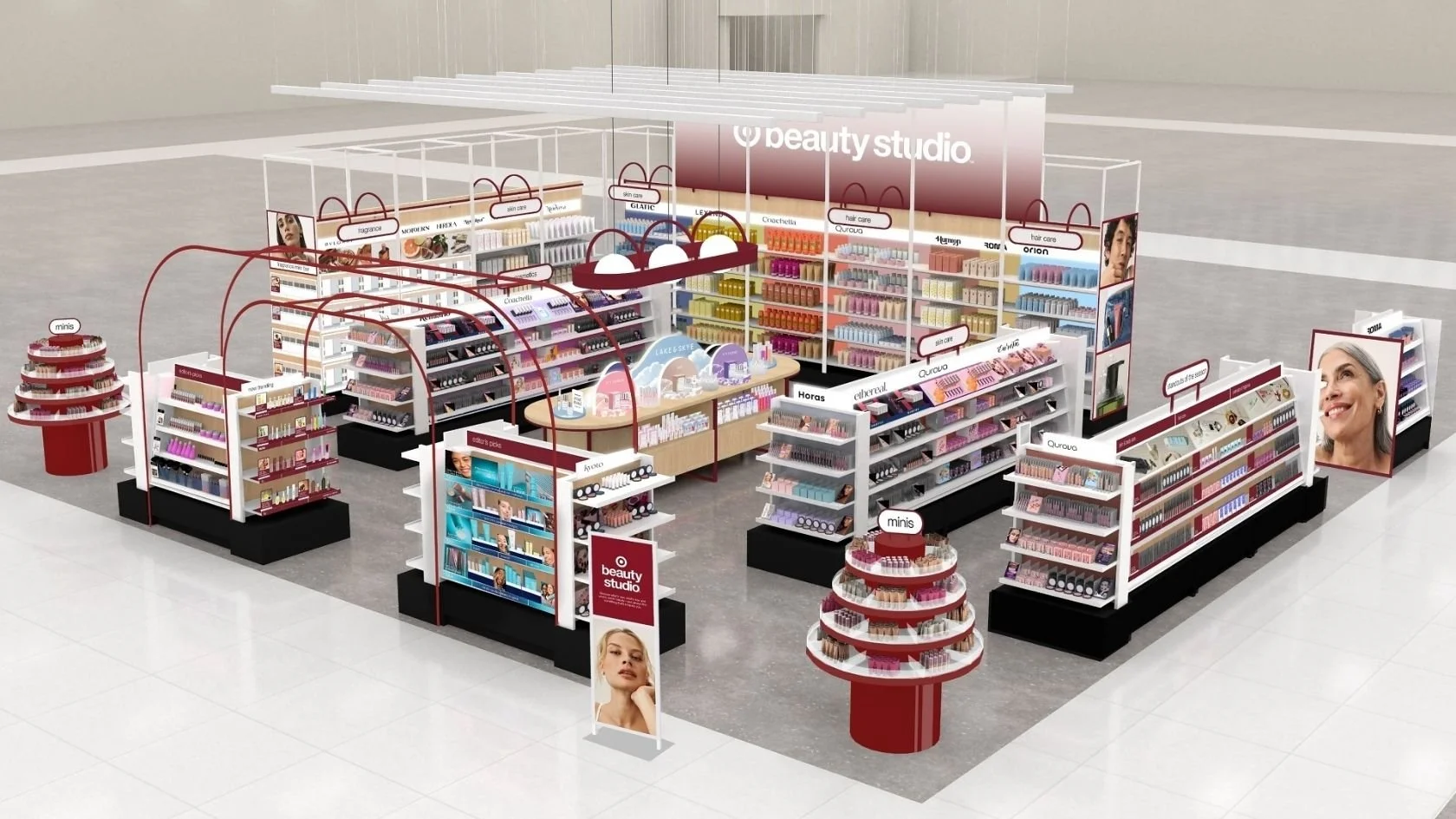
Target Beauty Studio is Target's new specialty-inspired beauty concept, launching in more than 600 stores with 1,600+ products from approximately 90 brands, dedicated Beauty Advisors, discovery tables, sampling and more curated product presentations.
Everyone knows you can find really fun, well-priced things for your closet, home, kitchen cupboards and more - and I’ve found plenty to love at stores on the East and West Coast over the years. There’s discovery in almost every department, including beauty and self-care.
But actually shopping in the Target beauty and self-care department however can be a real challenge.
Picture it - you’re looking for an eyebrow pencil and something placed on a swingy peg at ankle level catches your eye. At this point you’re practically forced into Downward Facing Dog just to peer at it - upside down!
Then, inevitably in said position, your eyeglasses fall off just as a mom pushing one of those enormous red carts, loaded with 25 items and doing her best to wrangle two children needs to get through the aisle - that BTW is barely wide enough for the cart.
So you kindly move out of the way, losing interest in the bottom pegged item, retrieve your glasses and notice an interesting lip-care brand you've seen influencers extolling on Instagram → and you wander over.
The display looks as though no one has touched it in weeks. Empty testers. Missing products. One or two shades in a never-going-to-work-for-your-skin-tone huddling sadly in the back of its 12-inch section. You lose interest again.
Other shoppers wander nearby looking for a particular brand they saw on a TV show. You happen to be standing next to its display, which for no apparent reason is behind locked doors, so you wave them over.
They thank you and look relieved. Then dismayed. Now … if only someone could find an employee with a key …
Beauty Shopping Is Supposed to Feel Different
Is it worth the struggle to save a few dollars? For me, not so much. I'd rather shop at a specialty beauty boutique like Citrine Natural Beauty Bar, Lemon Laine, Wren & Wild, AILLEA, The Detox Market - or Credo.
Unfortunately, there aren't many stores like those up here in the Napa Valley. We have world-class spas and Michelin-starred restaurants at every turn, but not much in the way of great independent beauty retailers.
We do, however, have Bluemercury. Owned by Macy's, Bluemercury isn't independent anymore, but you wouldn’t know it unless you looked it up. Its store personnel understand that careful curation, the value of product knowledge, and personal service are integral parts of the beauty-shopping experience.
Ask a question about a product and the salesperson generally doesn't stand in front of you reading the packaging to find the answer (a pet peeve!) - or worse, Google it on their phone while you wait. I can do that myself, thanks.
Great salespeople like those at stores like BlueMercury understand the lines. They know whom a product is best for, why it was selected for the store, and what else you might want to consider.
At Whole Foods, (at least in its Napa store) skincare gets a substantial, beautifully maintained section with knowledgable and interested staff nearby. It’s next to the vitamin and wellness section so they naturally co-exist as a wellness story. Cosmetics are much more limited and it’s clearly a deliberate choice. Rather than trying to compete with Ulta (which is just across the street) Target or Bluemercury (both in the same shopping center) across every beauty category, Whole Foods leans into the areas that fit naturally with its health-and-wellness authority. The result feels “chosen for you” rather than incomplete.
We also have Sephora and Ulta (as mentioned) up in these parts, which can be inconsistent with customer service depending upon location, but at least their stores are designed specifically around shopping for beauty. They offer testers, hand cleaning stations that are actually stocked, flattering lighting, accessible displays where yoga aptitude is not required, and aisles where two people can generally pass each other without drama.
Which brings me to Target.
Target Beauty Studio Is Coming to More Than 600 Stores
Target's announcement last week had plenty of people in the beauty industry raising their beautifully coiffed eyebrows, myself included.
After ending its five-year Ulta Beauty at Target partnership this month, Target announced Target Beauty Studio, a “new” self-care concept rolling out to more than 600 stores.
The Target Beauty Studio will feature more than 1,600 products from approximately 90 brands, with more than two-thirds of those brands new to Target (so 60 new ones if I’m doing the math right). But the most interesting part isn't the number of products so much as what Target is promising to do differently.
Beauty Studio will include dedicated Beauty Advisors offering personalized recommendations, central discovery tables, product testing and sampling, and more curated seasonal presentations. This is a big box store borrowing ideas that specialty and independent beauty retailers have long held dear: curation, discovery, expertise, and personal service.
The Numbers Explain Why Target Wants More of the Beauty Business
The economics behind this move make the company’s motivation clear. While Target's overall sales have slipped over the past few years, specialty beauty retailers have continued to perform remarkably well.
Ulta has grown from an approximately $8.6 billion business in 2021 to $12.4 billion in 2025, and just raised its outlook for 2026. Meanwhile Sephora continues to grow and gain market share.
While over at Target, overall net sales slipped from approximately $109 billion in 2022 to $105 billion in 2025.
While overall sales are slowing at Target, its beauty department is bucking that trend. Target's beauty sales grew from roughly $12.5 billion in 2023 to $13.2 billion in 2025 and are currently growing at a high-single-digit rate.
Target is trying to capture more of the booming specialty-beauty market of 2026 while protecting one of the healthier categories inside its own stores.
Whether Target can successfully translate the specialty-store experience into a mass retailer is another question.
We're months away from knowing whether adding more than 60 new brands to an already enormous beauty stock list will make shopping easier for customers, or simply create more inventory to navigate. And I'll be particularly interested to see whether those dedicated Beauty Advisors are still reliably staffing the Beauty Studios six months from now rather than being pulled elsewhere when stores are short-handed.
Target's "New" Beauty Brands Aren't Necessarily New
There's another distinction worth making, particularly for emerging beauty brands. More than two-thirds of the Beauty Studio brands may be new to Target, but that shouldn't be confused with new to retail. Most are very well established.
Beautyblender, Briogeo, Dyson, First Aid Beauty, IGK, Joico, Mario Badescu, Nioxin, Ouidad, Paul Mitchell, St. Tropez, StriVectin, Sunday Riley, Supergoop!, TULA and Wella for example are among the recognizable names coming to Target Studio.
Fragrance offerings include Coach, Dolce & Gabbana, Ariana Grande and Billie Eilish.
Several brands were already available through the former Ulta Beauty at Target partnership. Sunday Riley, for example, previously had an Ulta Beauty at Target collection. Many of the above brands are also readily available through Amazon and other major retailers.
Even some of the names that feel new are established elsewhere.
SARELLY, which Target is highlighting as one of its founder stories, already has substantial physical distribution in Mexico through retailers including Sephora, Ulta Beauty, Liverpool and Costco.
There are less familiar names on the coming stock list, including CHROMA, Gróa, Kayura, MIXIK SKIN, Modern Magic, Remilia, Smooch Body(Australian), Volo, and Buff Beauty.
But taken as a whole, Target Beauty Studio looks less like an incubator for undiscovered beauty startups and more like an edited assortment of established, international, digitally native and emerging brands that have already demonstrated some ability to attract attention.
Indie Brands and Retailers: Don't Try to Out-Target Target
If you run an independent beauty store, Target Beauty Studio should probably reinforce the value of doing the things a mass retailer has the hardest time delivering consistently.
Know your assortment intimately. Don't read the package back to a customer who asks a question. Know why you brought the product into the store, who loves it and who probably won't.
Introduce people to things they wouldn't have found themselves. That's one of the reasons customers visit a great independent store in the first place.
Give your assortment a point of view. Founder-led, treatment-oriented, ingredient-driven, design-conscious or difficult-to-find brands give your staff something worth explaining.
Don't duplicate endlessly. Target can carry dozens of solutions to the same problem because breadth is part of its proposition. An independent retailer has the luxury of saying, These are the four versions we think are worth carrying.
Merchandise beautifully. Put products where customers can see them, reach them, test them and understand why they belong together.
And most importantly, know your customers. You do not have to cover every category to feel like a serious beauty destination.
In fact strong retail concepts often have a very clear center of gravity:
Whole Foods credibly owns skincare, body care, clean ingredients and wellness-adjacent beauty.
CVS: convenience plus health/pharmacy authority.
Lemon Laine and Citrine: curation + intimacy + knowledgeable people.
Bluemercury: upscale curation and personal service at larger scale.
Credo: strong point of view, standards, education and curation, while scaling high-touch specialty retail.
Sephora and Ulta: enormous assortment + discovery + expertise + services.
Benefit BrowBars:specialization + service + demonstration.
Target Beauty Studio: trying to incorporate pieces of nearly all of these inside a mass merchant.
A small independent retailer can own sensitive skin, natural fragrance, clinical skincare, founder-led brands, luxury clean beauty, or whatever genuinely fits its customer.
That’s a point of view that contrasts nicely with Target, which needs to serve the person buying a $7 mascara, the person looking for prestige skincare, the teenager chasing a viral lip product, the salon-hair shopper and the fragrance customer, all inside the same department. A smaller retailer doesn't.
An independent retailer can remember what someone bought last time, know that she hated the texture of one sunscreen but loved another, tell her with all honesty when she doesn't need the expensive serum she's holding, call her when the fragrance she loved finally comes back into stock, and create a relationship that makes someone choose your store even when Target is five minutes away.
One of America's largest retailers has decided that the next opportunity in beauty involves more curation, more expertise, more discovery and more personal service - ie: what small specialty retailers already do well.
For independent beauty, the answer isn't to become more like Target, it's to become exceptionally good at everything Target wishes were easier to do at scale.

FAQs About Target Beauty Studio
What is Target Beauty Studio?
Target Beauty Studio is Target's new specialty-inspired beauty concept launching in more than 600 stores. It will feature more than 1,600 products from approximately 90 prestige, emerging and global beauty brands, along with dedicated Beauty Advisors, discovery tables, sampling, product testing and curated seasonal presentations.
When does Target Beauty Studio launch?
Target Beauty Studio begins launching September 10, 2026, following the end of the Ulta Beauty at Target partnership in August 2026.
Is Target Beauty Studio replacing Ulta Beauty at Target?
Target Beauty Studio follows the end of Target's five-year partnership with Ulta Beauty, which officially concluded in August 2026. Rather than continuing another retailer's shop-in-shop concept, Target is creating its own beauty experience and assortment.
Are the brands in Target Beauty Studio all new or emerging beauty brands?
No. Target says more than two-thirds of Beauty Studio's approximately 90 brands are new to Target, but many are already well-established elsewhere. The assortment includes familiar names such as Briogeo, First Aid Beauty, Sunday Riley, Supergoop!, TULA, Paul Mitchell and Wella, alongside international, digitally native and less established brands.
How is Target Beauty Studio different from Target's regular beauty department?
Target is positioning Beauty Studio as a more curated and service-oriented beauty experience. Dedicated Beauty Advisors, central discovery tables, sampling, product testing and specialty-level presentation are intended to make discovering and choosing beauty products easier than in a conventional mass-retail beauty aisle.
What does Target Beauty Studio mean for independent beauty retailers?
Independent stores cannot realistically compete with Target on scale, purchasing power or assortment. Their advantage lies in doing what specialty retail does particularly well: tightly editing their assortments, knowing products intimately, introducing customers to unfamiliar brands, providing knowledgeable recommendations, creating distinctive merchandising and developing trusted relationships with local customers.
What does Target Beauty Studio mean for emerging beauty brands?
Target's assortment demonstrates that major retail distribution often follows rather than creates brand recognition. Emerging brands can strengthen their retail prospects by developing recognizable hero products, distinctive packaging, clear positioning, founder stories, retailer education and outside awareness through PR, social media, sampling and word of mouth.