50 Years Ago, a Tiny PR Event Transformed an Entire Industry. Here’s What Brands Can Learn From It.
A promotional wine tasting in Paris accidentally toppled centuries of conventional wisdom. Fifty years later, the Judgment of Paris is still one of the best PR lessons a small brand could study.
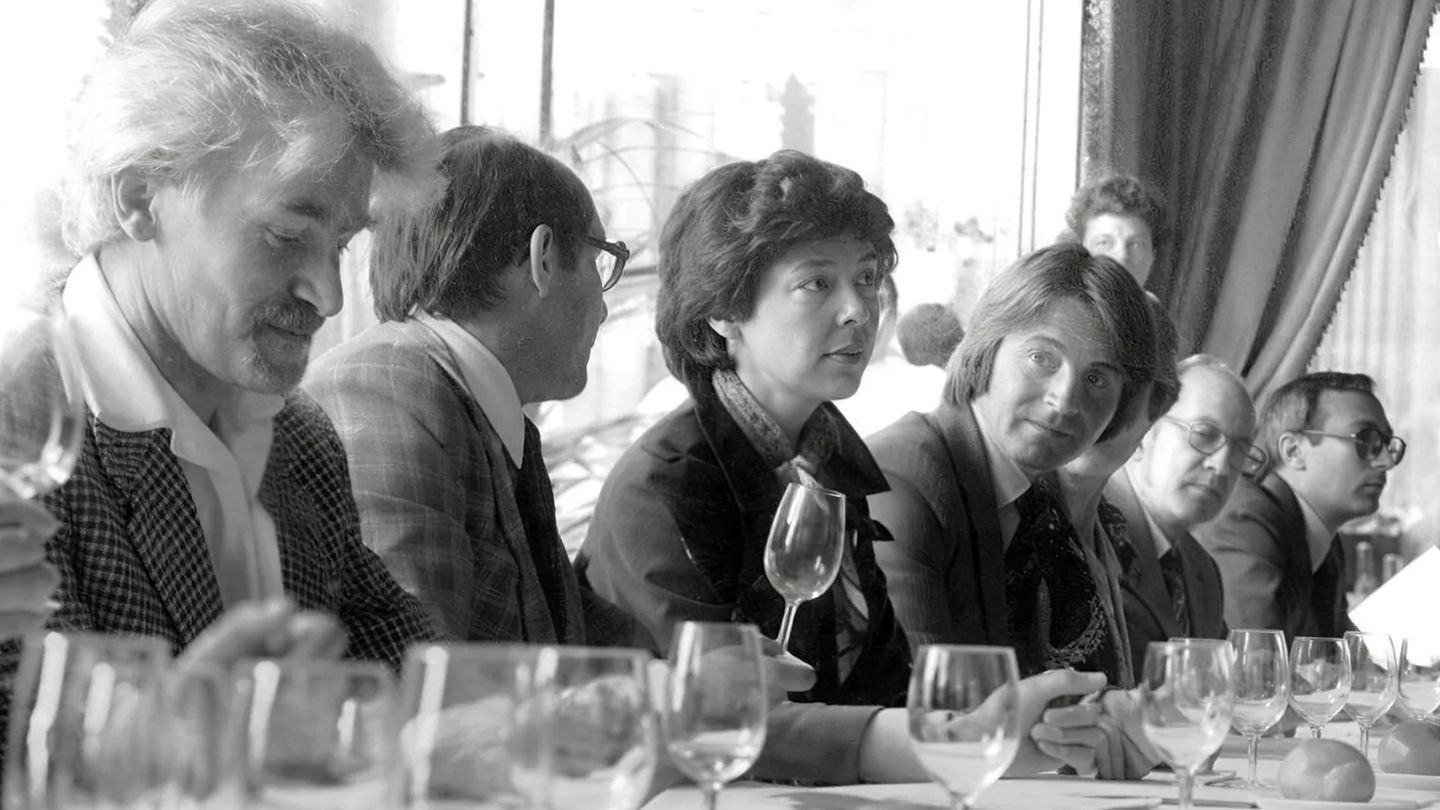
9 wine experts accidentally changed everything - 50 years later we’re still talking about it.
At a glance: The Judgment of Paris was a 1976 blind wine tasting in Paris in which California wines unexpectedly beat prestigious French wines. Organized by British wine merchant Steven Spurrier and Patricia Gallagher, the event became a landmark example of how a timely hook, independent experts, brand-blind testing and one well-placed media story can completely change perception.
It’s early Autumn, and down in the Napa Valley they’re starting to harvest grapes for their 2026 vintages. On a Monday or Tuesday it’s pretty quiet around here, but on the weekends the area swells with tourists of all kinds: folks from The City visiting their weekend homes, wedding parties, and foodies from all over the world.
When I was growing up, Napa and Sonoma felt very different. I came up to The Valley on weekends for horse shows as a kid in the 1970s, and let me tell you, it was rural. Beautiful, certainly, but the rolling hills were mainly filled with orchards, cattle ranches, farmland and a relatively modest collection of vineyards.
There was nothing remotely resembling the highly polished wine, culinary, resort and spa culture that inhabits the region today. So what changed?
That brings us to the 50th anniversary of the Judgment of Paris, one of the most consequential PR events in modern history.
Loosely dramatized in the film Bottle Shock, starring the late Alan Rickman, the story gets its now-famous name from the headline attached to a tiny four-paragraph article published in Time magazine after the event.
By today’s standards it was not a placement most clients would consider terribly exciting. It was four measly paragraphs jammed into a sidebar next to a ¾ page Armstrong tire advertisement. Not even a byline graced the piece.
And yet, WOW, what an impact.
There are splashy PR campaigns with seven-figure budgets, celebrity ambassadors, elaborately orchestrated press previews and media lists containing hundreds of names. And then there was the Judgment of Paris.
It Began With a Very Good PR Peg
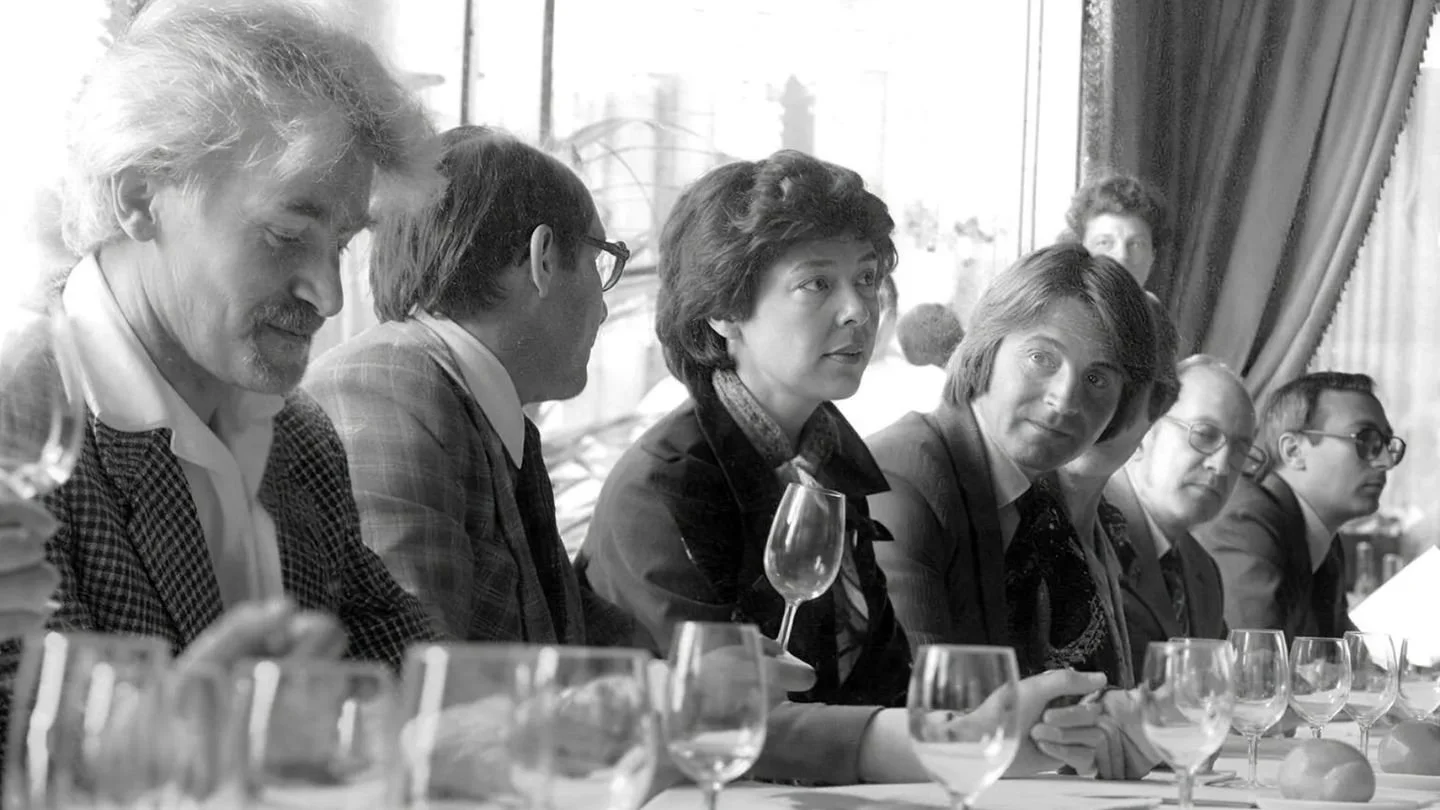
On May 24, 1976, British wine merchant Steven Spurrier and his American colleague Patricia Gallagher gathered some of France’s most respected wine authorities at the InterContinental Hotel in Paris.
Prior to this exact date, France (and to a lesser degree Italy) dominated the wine industry. California wine → or really vintages from any other country were largely considered non-entities. A bottle of Cabernet Sauvignon from a Northern California vineyard was considered with the same regard as something your uncle might have made as a part of a weekend hobby → endearing, but really?
Our dear Spurrier ran a Paris wine shop and the L’Académie du Vin wine school, which catered heavily to English-speaking wine lovers. American winemakers passing through Paris occasionally brought California wines for Spurrier and his staff to taste. And guess what? The wines were good.
The adventurous Gallagher had visited Napa Valley in 1975 and came away particularly impressed by the Chardonnays and Cabernet Sauvignons being produced there. She suggested holding an event in Paris to bring some attention to them. Then she supplied the thing every good PR campaign needs:
A timely hook.
1976 was the 200th anniversary of American independence. Ahhh... Vive l’Amérique!
Why not use the Bicentennial to introduce respected French wine authorities to some of the best wines being produced in America C’est une super idée.
Spurrier traveled to California, much as was depicted in Bottle Shock, selected six Chardonnays and six Cabernet Sauvignons, and invited prominent French wine experts to taste them. His Académie had enough credibility that they agreed.
And this is worth remembering: The Judgment of Paris wasn’t the brainchild of a giant advertising agency, a massive California wine consortium or a room full of seasoned marketing executives.
It grew from an earnest idea kicked around by an independent wine merchant and the woman running his wine school.
At first, it was simply a clever promotional tasting, never intended to embarass anyone or upend anything. But then … Spurrier made one decision that changed everything.
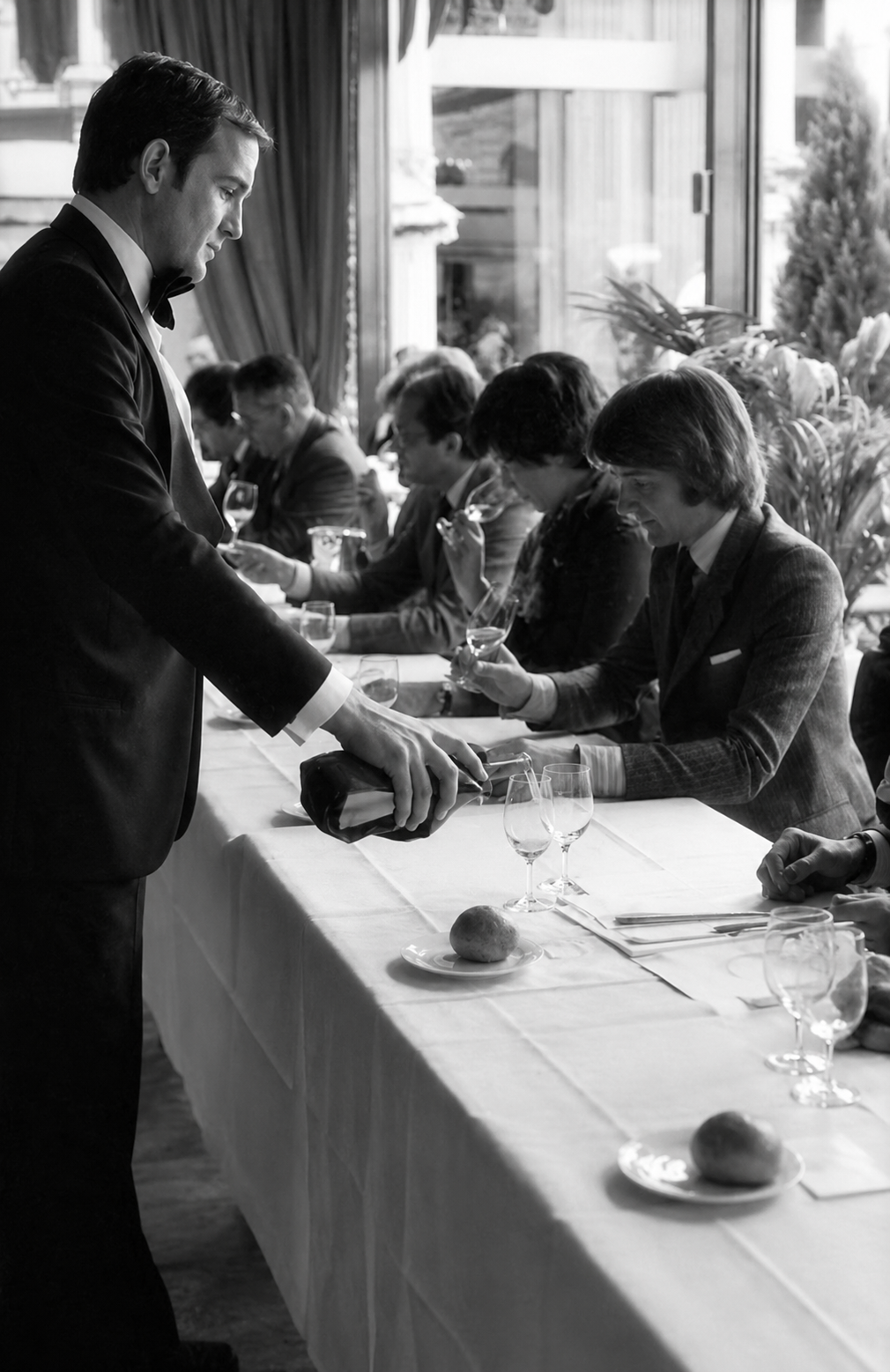
Above: Blind wine tasting with unlabeled bottles at The Judgement of Paris
The Labels Came Off
The tasting was not originally supposed to be blind. But Spurrier worried about something every publicist or marketer working with a little-known company understands: brand bias.
If the judges knew which bottles came from California, would they really give them a fair hearing? Or would centuries of reputation make the decision before anyone even lifted a glass? So Spurrier added prestigious French wines to the tasting and concealed the identities of all the bottles.
That may have been the most important marketing decision of the entire event, because removing the labels also removed the accumulated power of the brands.
No château.
No appellation.
No famous French provenance.
No prestigious label.
No centuries-old reputation.
For a few minutes, California wine didn’t have to compete with Burgundy’s mythology or Bordeaux’s status, all that mattered was what was actually in the glass. The event inadvertantly became a genuine experiment in brand perception.
And almost immediately, things got awkward.
French chef and judge Raymond Oliver tasted one of the white wines and reportedly exclaimed:
“Ah, back to France!” Whoops. His glass contained a 1972 Chardonnay from Freemark Abbey in Napa Valley.
Another judge dismissed one wine as obviously Californian which was actually French.
And Then California Won
When the white wine scores were totaled, first place went to the 1973 Chateau Montelena Chardonnay, made by winemaker Mike Grgich. Not Burgundy. California.
Then came the reds. First place went to the 1973 Stag’s Leap Wine Cellars Cabernet Sauvignon, made by Warren Winiarski. Again California.
In 2026, when excellent wine comes from California, Australia, New Zealand, South Africa, Chile, Argentina and countless other places around the world, that may not sound particularly revolutionary, but in 1976, it was seismic.
You could say that in the year of the Bicentennial of American Independence, California had staged it’s own revolution.
The tasting challenged one of the wine world’s deepest assumptions: that truly great wine was essentially a French birthright. Surely everyone from California was celebrating wildly, right?
Not exactly. The California winemakers weren’t even in the room. Some didn't know they had won, or even entered, until they were contacted afterward. Which brings us to perhaps the most fascinating PR lesson of the entire story.
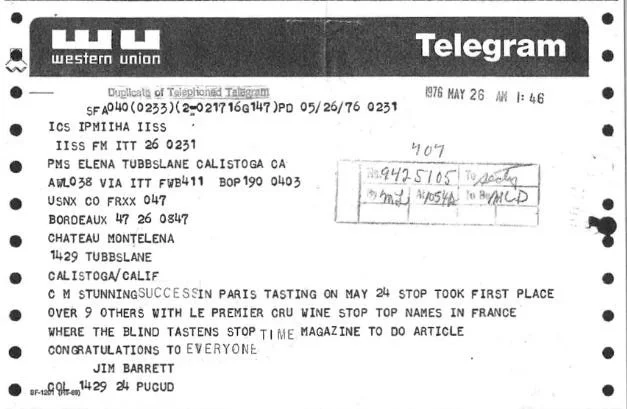
Life before texting! This Western Union telegram was how many of the vintners from California found out that they’d won.
The Greatest PR Event Nobody Wanted to Cover
Spurrier invited the press - American, French - anyone that would pay attention, but no one took the event seriously, so no one came, with one lone exception.
George Taber, a correspondent in Time magazine’s Paris bureau, had initially turned down the invitation, but that dreary Monday in May of 1976 was apparently a slow newsday - so off he went. As it turned out Taber, a lone journalist writing a tiny story that he thought few would read, decided to let it rip.
As French judges confidently misidentified California wines as French, and French wines as Californian, the predictable little wine tasting was turning into a true routing. C'était un véritable exploit pour ce Petit Poucet!
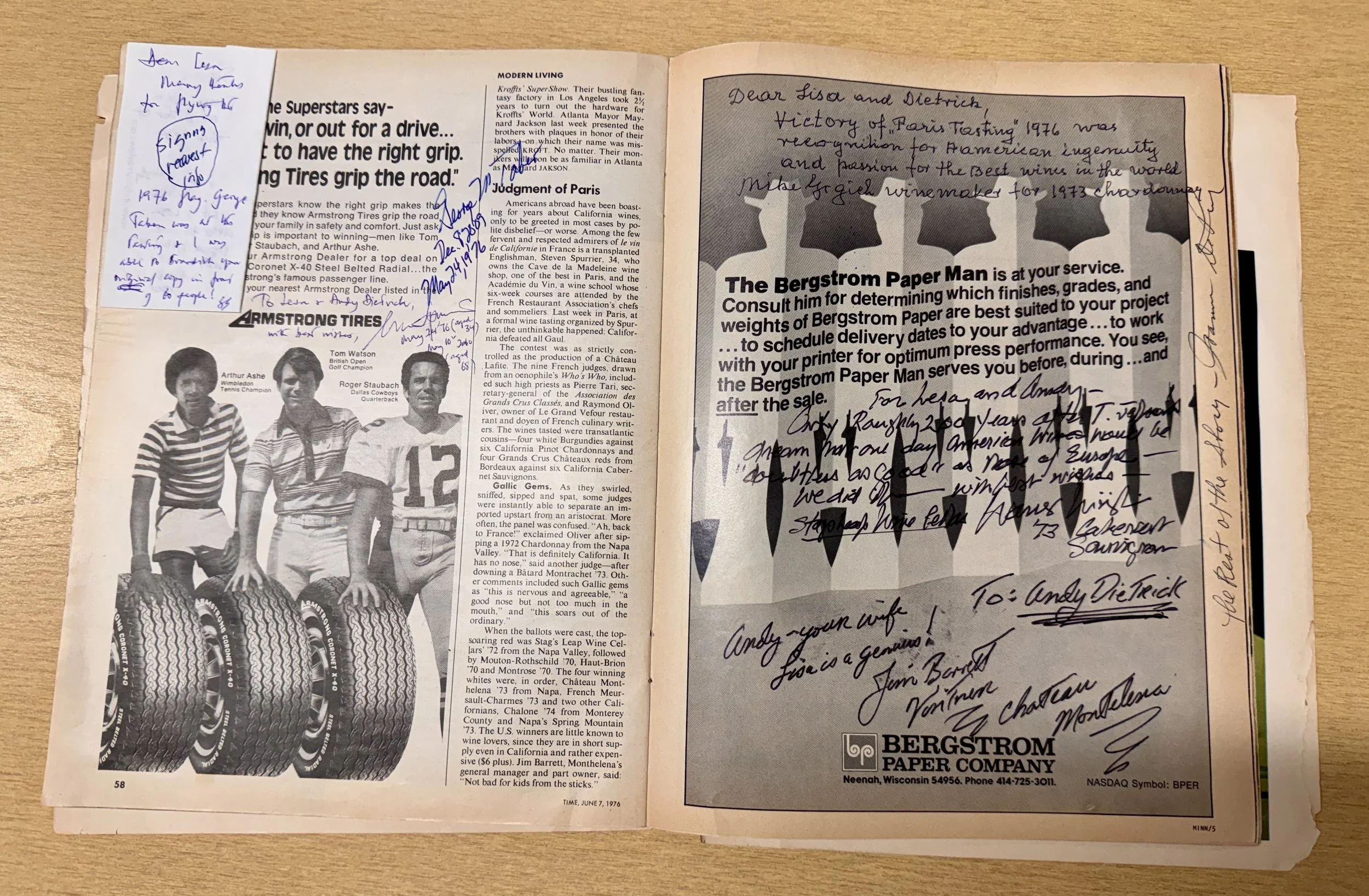
Above: A copy of an original Time Magazine signed by George Tabor and others involved. It lives at the St Helena Wine Library if you’d like to visit it in person.
Four Paragraphs Changed Everything
Despite the gravity of the event, the resulting Time article was just four paragraphs long and didn't even carry Taber’s byline - but Time was one of the most influential publications in the world - and Taber’s unvarnished recounting of the event interspliced with ridiculous commentary from the judges caught people’s attention.
Gallic Gems. As they swirled, sniffed, sipped and spat, some judges were instantly able to separate an imported upstart from an aristocrat. More often, the panel was confused. “Ah, back to France!” exclaimed Oliver after sipping a 1972 Chardonnay from the Napa Valley. “That is definitely California. It has no nose,” said another judge—after downing a Batard Montrachet ’73. Other comments included such Gallic gems as “this is nervous and agreeable,” “a good nose but not too much in the mouth,” and “this soars out of the ordinary.” Time Magazine June 1976
With Taber as the only journalist in the room, Time owned the story. There were no competing hot takes, or 20 other journalists influencing or diluting Taber’s experience of the event.
The Result Was Genuinely Shocking, here’s the text from Time:
When the ballots were cast, the top-soaring red was Stag’s Leap Wine Cellars’ ’72 from the Napa Valley, followed by Mouton-Rothschild ’70, Haut-Brion ’70 and Montrose ’70. The four winning whites were, in order, Chateau Mont-helena ’73 from Napa, French Meursault-Charmes ’73 and two other Californians, Chalone ’74 from Monterey County and Napa’s Spring Mountain ’73. The U.S. winners are little known to wine lovers, since they are in short supply even in California and rather expensive ($6 plus). Jim Barrett, Monthelena’s general manager and part owner, said: “Not bad for kids from the sticks.”
One judge, Odette Kahn, was reportedly so upset by the result that she wanted her scorecard returned. You could barely design better narrative tension if you tried.
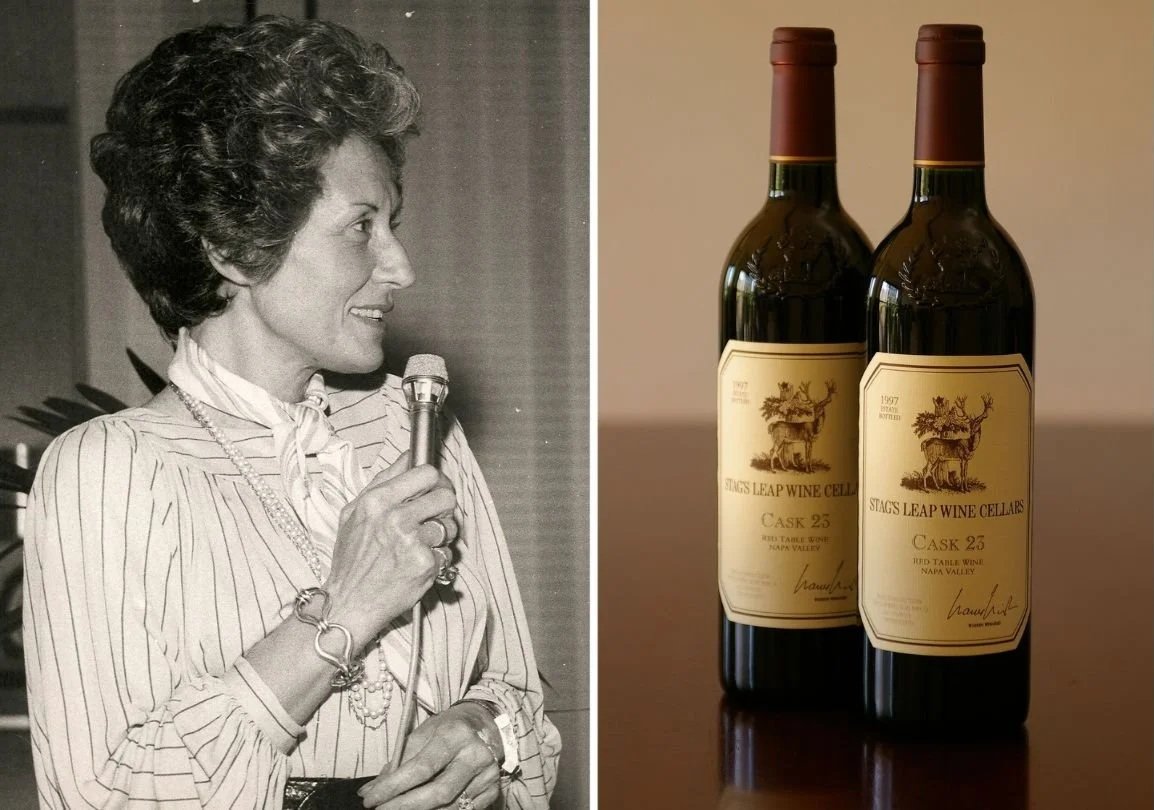
Above: Even though she judged Stag’s Leap as her favorite red, when the results were announced French judge Odette Kahn attempted to rescind her decision.
Because Time Had an Enormous Audience, this quirky local event was instantly transported onto a global stage. Soon other media outlets followed with follow up stories, and the tasting went from obscure event to cultural legend.
The Story Had an Unforgettable Name
Someone at Time supplied the headline“Judgment of Paris,” a clever reference to the ancient Greek myth of Paris being called upon to judge which goddess was the fairest.
George Taber may have written the story, but an unknown editor appears to deserve credit for that final bit of marketing magic - giving this little tasting something every great story needs: a title people still remember.
The Most Important Detail May Be Who Didn’t Organize It
There’s another reason the Judgment of Paris carried so much credibility. California didn’t stage its own victory.
Steven Spurrier was British, and the tasting took place in Paris with judges who were eminent French wine professionals. The benchmark wines included some of France’s most prestigious and the California wineries weren't standing in the room lobbying, presenting decks or explaining why everyone should appreciate their wines. They were lucky bystanders.
Imagine how different the story would have sounded if a Napa winery had hosted a tasting in California, invited a panel of California wine enthusiasts and then issued a press release announcing: CALIFORNIA WINE BEATS FRANCE! Everyone would laugh.
What Happened Next Was Far Bigger Than Wine
California wine - and the state as a whole - gained a legitimacy it had never possessed before. Investment followed and vineyards began to transform the Napa Valley region.
There are still pockets of the old Napa Valley that I remember as a kid, but it’s been greatly transformed both spiritually and literally over the 5 decades since the Judgement of Paris. Would this metamorphosis have happened even if the Judgement of Paris had never taken place? I’ll let you decide.
The two winning bottles reside in the Smithsonian’s National Museum of American History. Chateau Montelena and Stag’s Leap became part of American wine history, and the tasting is widely credited with helping transform perceptions of California and New World wine.
And it’s been far more than wine culture that’s made over the Napa Valley in five short decades. With investments came elaborate country houses designed by world class architects; resorts and spas to rival any on the planet; country clubs and couture; and some of the best restaurants in the world.
That’s an astonishing afterlife for what began as a small promotional event, and when you think about it, that’s the best lesson the Judgment of Paris can offer smaller brands in 2026.
How Brands Can Create Their Own Blind Product Test
1. Test Your Brand Against the Standard, Not the Easy Win
Don't fill the table with products you know you can beat. One of the reasons the Judgment of Paris mattered was that Spurrier put relatively unknown California wines in the same tasting as prestigious French wines that represented the accepted standard of excellence. They were the underdogs not expected to win.
Olay has used this strategy particularly well. In a 2017 Good Housekeeping Institute evaluation, its Regenerist Micro-Sculpting Cream was tested against 10 prestige moisturizers, including one costing hundreds of dollars more. In blind comparisons, consumers preferredOlay 80% of the time.
2. Remove the Brand Bias
Remove or disguise anything that reveals who made each product.
For fragrance, use identical unmarked blotters or sample bottles.
For lipstick, depot the products or have someone apply them so testers never see the tubes.
For candles, use identical vessels if possible, or conduct the scent evaluation without allowing participants to see the packaging.
For food, use identical plates, bowls or cups.
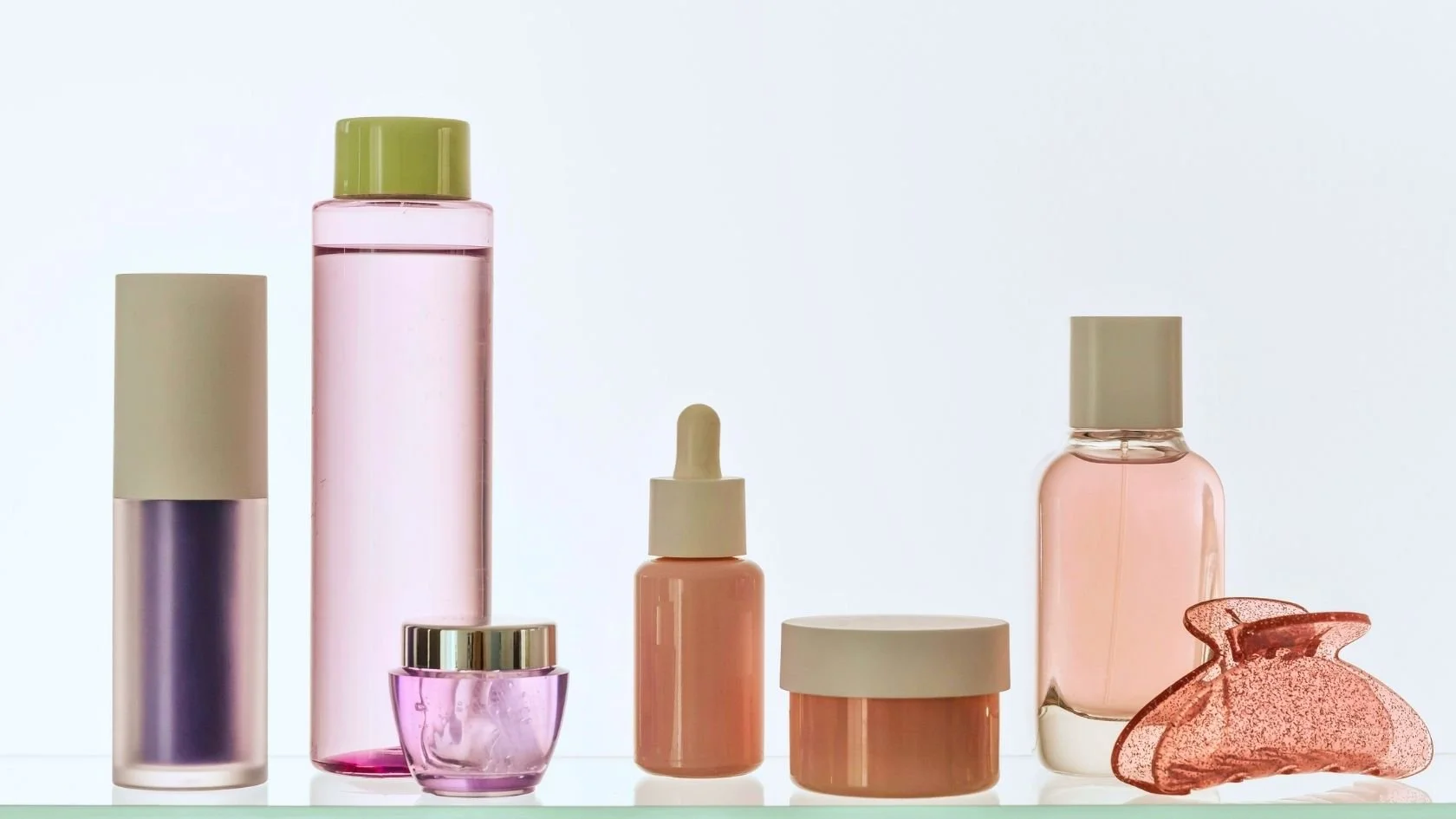
For skincare, transfer the products into matching sample containers marked A, B, C and D.
Someone who isn't participating in the judging should randomize the products and keep the answer key.
Your test should answer a genuinely useful marketing question: What happens when consumers can't see the logo?
3. Create Specific Criteria and Scorecards
Vague criteria can lead to inconclusive results - which is a waste of time. Give your judges specific variables to wrap their opinions around.
A fragrance might be scored on:
First impression
Complexity
Longevity
Distinctiveness
Overall preference
A lipstick could be judged on:
Application
Color payoff
Comfort
Appearance and plumping
Transfer or bleeding
Wear
A candle might be evaluated for:
Cold scent and hot throw
Burn time
Fragrance complexity
Room fill
Wick smoke
4. Use Independent Testers and Publish the Real Results
Invite a small group of people with some credibility and experience in your category - they could be:
Retailers
Makeup artists or aestheticians
Interior designers
Beauty professionals
Editors or writers
Chefs
Fragrance enthusiasts
Longtime customers
Other knowledgeable experts
Tell participants in advance that the results may be published and commit to publishing the results even if your product doesn't finish first.
5. Don't Be Your Own Judge
Don't conduct the test, judge the entries, tally the scores and then announce your own victory if you can possibly avoid it. Bring in someone independent to help conduct the event.
A retailer
An industry expert
A journalist
A professional in your category
A respected creator
A local organization
A trade group
An independent event host
Ideally, the event organizers should have no particular reason to favor your company. The farther your brand can remove itself from controlling the outcome, the more credible and interesting the result becomes - uncertainty is part of what makes the event worth reading about.
FAQ’s
What was the Judgment of Paris?
The Judgment of Paris was a blind wine tasting held in Paris on May 24, 1976. French wine experts unexpectedly ranked California wines ahead of prestigious French competitors in both the white and red wine categories.
Why was the Judgment of Paris important to marketing?
The event demonstrated how powerful independent validation can be. Removing the wine labels eliminated much of the judges' brand bias, while credible outside experts and an unexpected result transformed a small promotional event into international news.
Can a small brand conduct a blind product test?
Yes. Products including fragrance, candles, lipstick, skincare, food and beverages can be tested blind as long as identifying packaging is removed, comparable products are selected and consistent evaluation criteria are established.
What makes a blind product test credible?
Use legitimate competitors, remove identifying brand information, establish scoring criteria before testing begins and involve independent judges who have no particular reason to favor your brand. Most importantly, don't design the test around guaranteeing that your own product wins.